
Some battlefields feel like wide-open stages. Guilford Courthouse feels like a story whispered through trees. The first time I walked it, I remember thinking, this is exactly why Nathanael Greene was so hard to beat. He did not need to win the day in a clean, dramatic rout. He needed to make the British pay for every yard, every volley, every decision.
On March 15, 1781, that idea played out in full. The British held the field at the Battle of Guilford Courthouse, but they did it at a cost they could not comfortably afford.
That is what Guilford Courthouse National Military Park in Greensboro, North Carolina still teaches best. If you walk it like a tour instead of a hike, meaning you stop at markers, look back over the ground you just crossed, and keep the three-line sequence in mind, you can watch Greene’s plan unfold in three acts. You can also see why Lord Cornwallis technically “won” the field and still staggered away wounded in everything that mattered.

Before you start
Guilford Courthouse is one of those parks that works for almost any style of visit. You can do a quick orientation loop in an hour, or you can linger all afternoon reading the ground like an old campaign map. It helps to know two things up front: there is a visitor center area (when open), and the park experience is a mix of walking paths and a driving loop that connects key points.
My simple game plan
- Begin at the visitor center if it is open. Even a short stop helps you match what you see on the trail to what happened in 1781.
- Walk, do not just drive. The battle makes sense at foot speed, because the lines were set in woods and broken fields where visibility came and went.
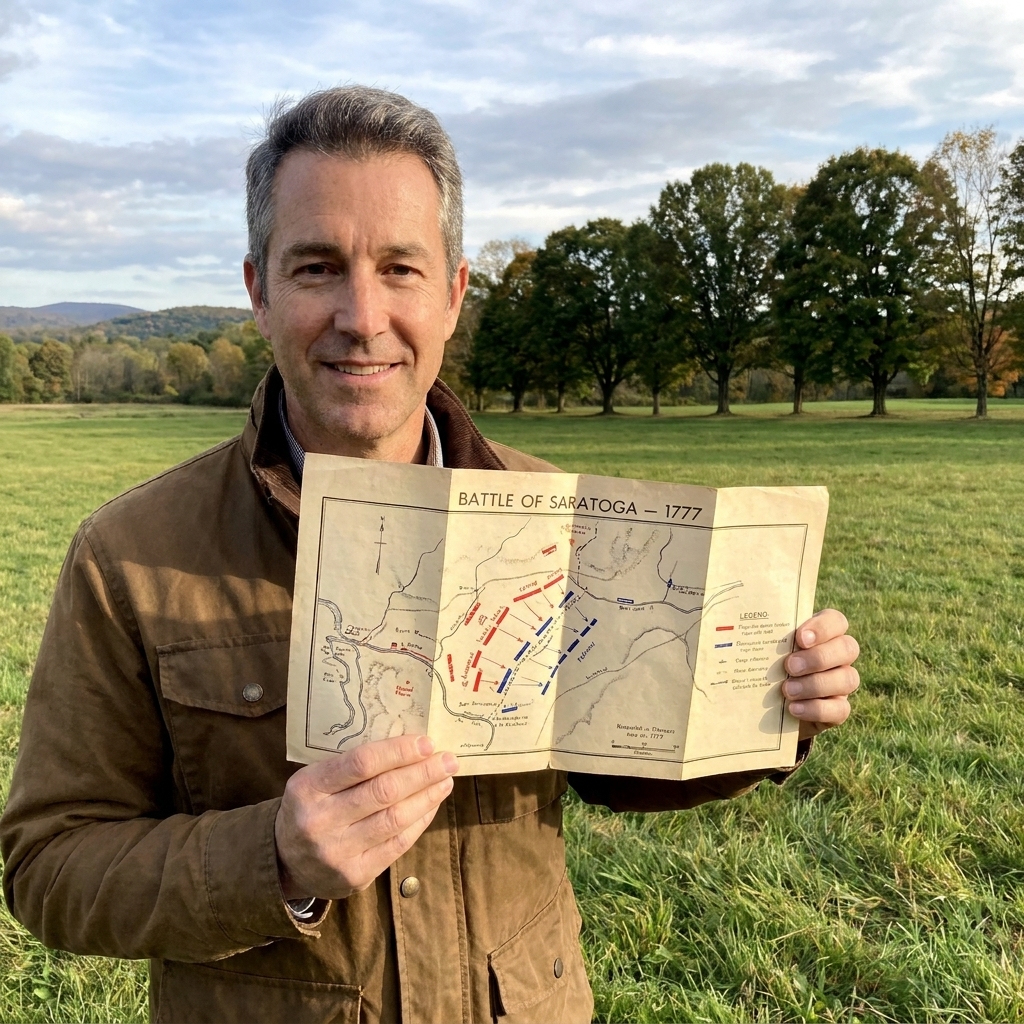
- Bring one “map brain” tool. I like a small notebook or a saved screenshot of the park map on my phone. If you want to get better at reading battlefield terrain anywhere, my primer is here: How to Read Revolutionary War Battlefield Maps On-Site.
- Good shoes matter more than gear. You are walking the same kind of rolling Piedmont ground that shaped the fight.
If you are building this into a longer Southern Campaign trip, Guilford pairs naturally with Greene’s earlier chess match at Cowpens. I keep notes for that visit here: The Battle of Cowpens.
Why Greene fought here
To understand the trails, you need to understand Greene’s goal. In early 1781, Greene was running a controlled risk. He wanted Cornwallis to chase him, stretch his supply lines, and burn through men he could not easily replace. A decisive American victory would have been nice, but a costly British victory could be even better.
After weeks of maneuvering, Greene accepted battle on ground near Guilford Courthouse and set up a defense in depth: three lines, each meant to delay, damage, and disorder the British advance. Then, when the moment came, he could withdraw in good order and live to fight again.
At Guilford, Greene did not gamble everything on one line holding. He asked each line to do a job, then yield the stage to the next.
Walk the three lines
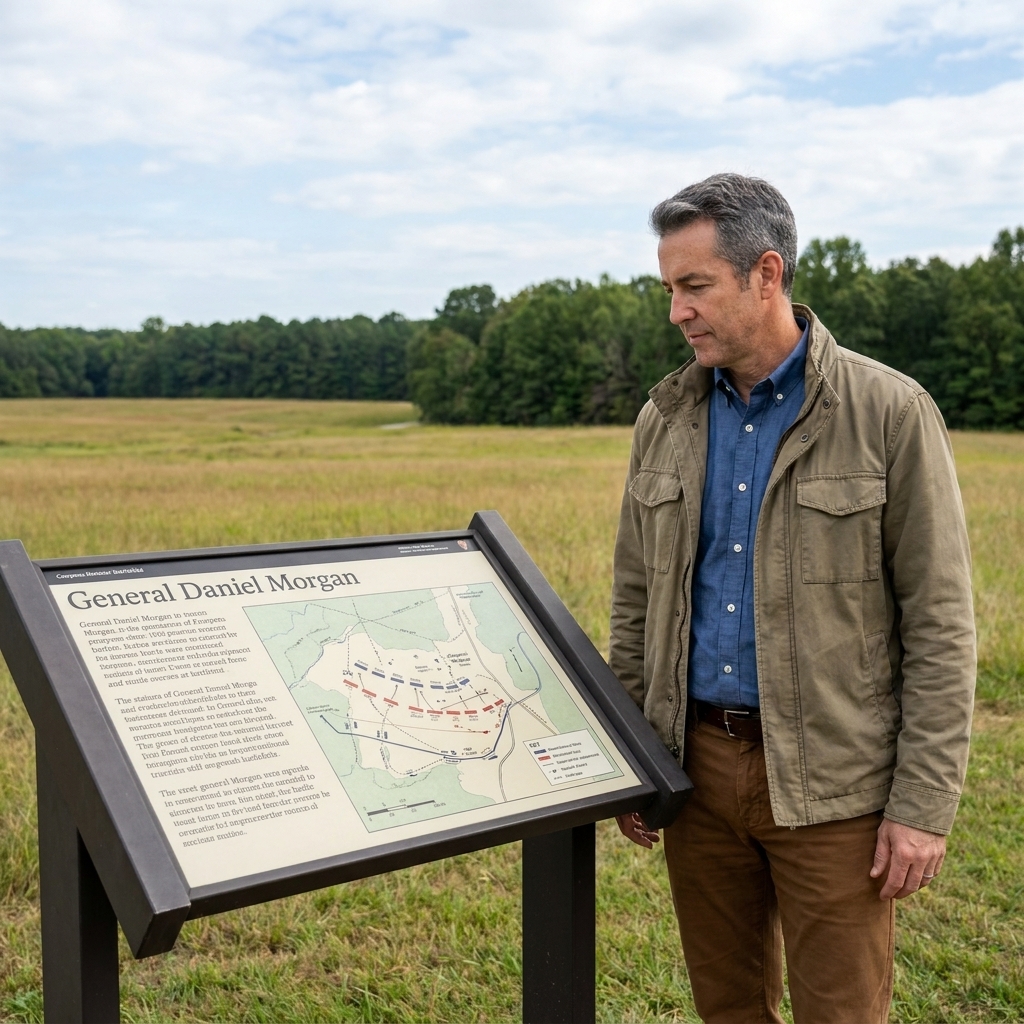
Different loops and spurs in the park connect key markers, monuments, and the general footprint of the fighting. Rather than giving you turn by turn directions, I want to give you a way to walk that matches the battle’s rhythm. Use the park signage as your guideposts, and use the terrain to understand why things went the way they did.
Stop 1: The British approach problem
Start by putting yourself in Cornwallis’s boots. The British came on expecting to brush aside an initial militia line and keep moving. Instead, they met a defense layered across broken ground where units could lose contact, smoke would hang between trunks, and commands would arrive late or not at all.
As you walk through the woods, look for how quickly sightlines disappear. At Guilford, “out of view” often meant “out of control.”

Stop 2: The first line
Greene’s first line leaned on North Carolina militia. Militia gets an unfair reputation when we forget what commanders actually asked them to do. Here, the first line’s job was not to stand forever. It was to fire, to create uncertainty, and to make the British deploy and commit.
When you stand where the woods begin to open and close in small pockets, picture militia firing a few hard volleys, then falling back. The tactical question was never “will militia beat British regulars in a stand-up duel?” It was “will militia buy enough time and cost enough blood before they break?”
Stop 3: The second line
The second line was anchored mostly by Virginia militia, with the whole position designed to fight harder and longer than the first. This is where the battlefield starts to feel like Greene’s real design. The distance between lines mattered. Too close and the retreat becomes a panic that drags everyone with it. Too far and the British reset and come on fresh.
As you walk, pay attention to gentle rises and dips. Even small elevation changes become major when muskets are effective at relatively short range and smoke clouds the understory. Greene was using folds in the land the way later commanders used earthworks.
Stop 4: The third line
The third line was the backbone: Continental troops who could trade volleys with British regulars and not evaporate. By the time Cornwallis reached them, his army had been fighting, reforming, and absorbing losses. That was the point.
This is also where Guilford stops being a neat textbook diagram and becomes a messy, human battle. Units got separated. Attacks came in uneven waves. Counterattacks flared up, then died. On the ground today, that “mess” often reads as a confusing tangle of woods and paths, which is exactly how it felt to men trying to keep alignment under fire.
The moment that explains it
If you only remember one battlefield lesson from Guilford, make it this: Cornwallis reached a point where the fight collapsed into close range confusion, with formations tangled and his own troops in danger in the crush.
His solution was brutal and revealing. He ordered artillery to fire case shot into the mass, even though it meant striking friend and foe together. On the trail, when you find yourself in tighter spaces where lines would naturally compress, pause and think about what that order admits: the British “victory” was turning into something dangerous, expensive, and hard to control.
Greene withdrew, Cornwallis held the ground, and the British army was left more battered than a win could justify.
How to read the ground
1) Watch the edges
Revolutionary War fighting loves transitions: woods to open ground, road corridors, creek bottoms. Every time you step from shade into sun, ask: Would I want to form a line here, or avoid it?
2) Measure distance by pace
I do this constantly. Walk a hundred paces, stop, and look back. Ask yourself how much you can see, and how quickly a retreat could become confused if smoke and shouting filled that space.
3) Use monuments as anchors
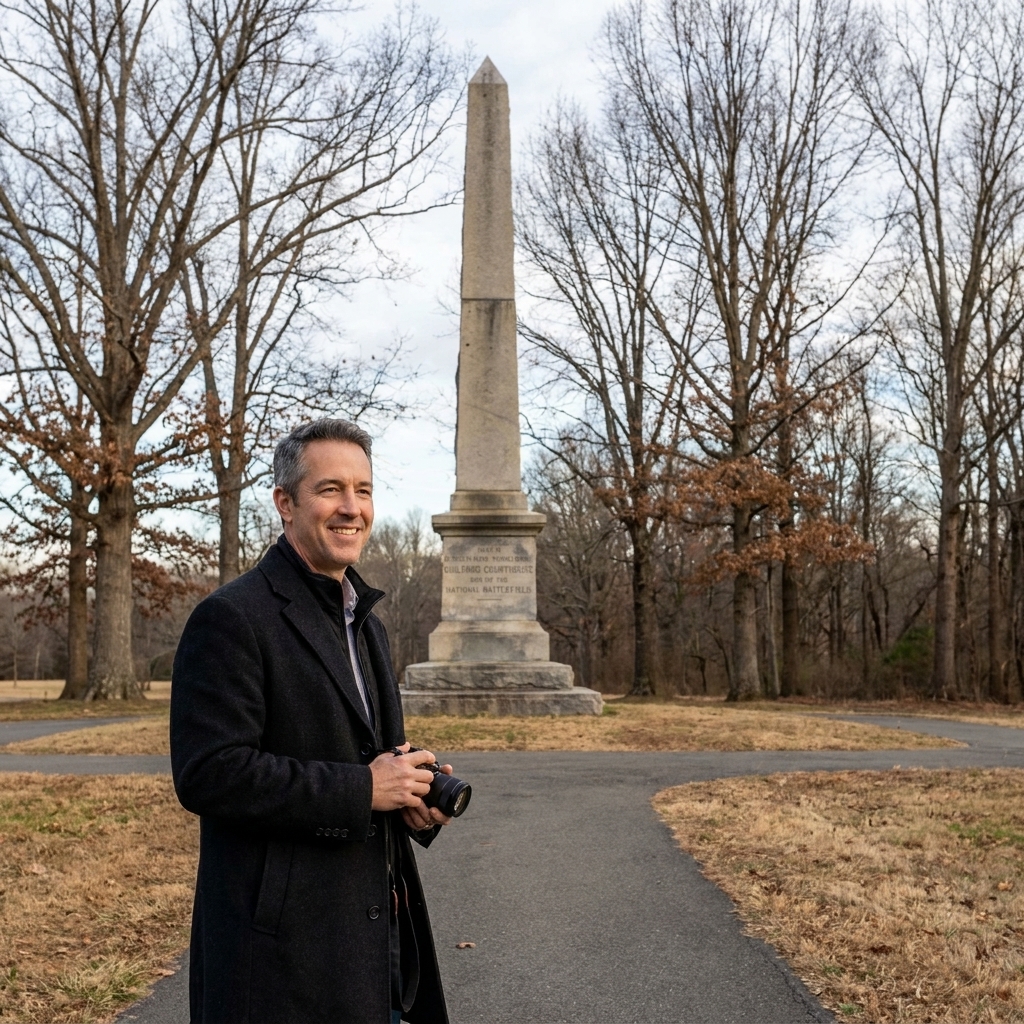
Guilford has a lot of commemorative stone for a battlefield that feels so wooded. That is not a contradiction. Use monument clusters and big markers as “pins” on your mental map, then walk a short distance away from them and notice how fast the forest swallows the view again.
A 90-minute walk
Here is the rhythm I recommend to friends who want the story and the terrain, not a marathon.
- Visitor center orientation and a quick look at exhibits if available.
- Walk with one goal: find the three-line concept. As you reach markers that reference militia, then Virginia troops, then Continentals, treat them like chapters.
- Pick two “look back” stops. One early to feel the British approach problem, and one late to feel how the endgame compresses into confusion.
- Finish at a monument cluster and take five minutes to connect memory to place.
Visiting with kids
I have found that Guilford works well for families because the woods naturally turn it into a mission.
- Give them a job: find a place where you would hide, a place where you would not want to cross, and a place where you could see farthest.
- Teach one word: “line.” Then ask, “Where would you put the first line? The second?”
- Keep it short: one loop done well beats three loops done tired.
If you are planning a broader trip built around kid-friendly sites, you might also like: Top 5 Revolutionary War Battlefields to Visit With Kids.
What Guilford changed
Guilford Courthouse did not end the war in the South. It did something subtler and, in the long run, more decisive. It took a British army that could still strike hard and made it less able to absorb another punishing fight.
Greene’s masterpiece here is not a tidy battlefield “win.” It is a lesson in strategic pressure. Cornwallis could claim the field, but the cost helped steer his campaign toward choices that carried him to the coast, then into Virginia, and eventually into the tightening trap at Yorktown.
That is why Guilford is worth walking slowly. You are not just tracing lines. You are watching a war of endurance play out under hardwood trees.
Quick FAQ
Is this a good stop if I am not a hardcore history buff?
Yes. The park reads well even if you only remember two names. You can enjoy it as a peaceful wooded walk, and still come away understanding why the battle mattered.
What if I only have 30 minutes?
Focus on the three-line idea. Look for signage that references militia and Continentals, and let that progression be your story.
How does Guilford compare to other Southern battlefields?
Cowpens feels like a clean tactical puzzle. Guilford feels like controlled chaos and attrition. If you enjoy seeing how terrain shapes command and control, Guilford is the one that sticks with you.