

I have learned over the years that you can read a general’s dispatches all night and still miss something simple: how he liked to work. Put me in a preserved headquarters room, with its doorways, windows, and sightlines, and suddenly command decisions stop feeling abstract. You start to notice what a commander could see, what he could not, and how close he kept himself to the problems on the ground.
Two British leaders make for a particularly revealing comparison: General Sir William Howe and Lieutenant General Lord Charles Cornwallis. Howe served as British commander in chief in America from 1776 to 1778. He is remembered for taking big prizes like New York and Philadelphia and also often criticized for not turning battlefield success into a war-ending blow. Cornwallis later became the leading British field commander in the southern theater, pushing hard, moving fast, and finishing the war besieged at Yorktown.
How to read a headquarters
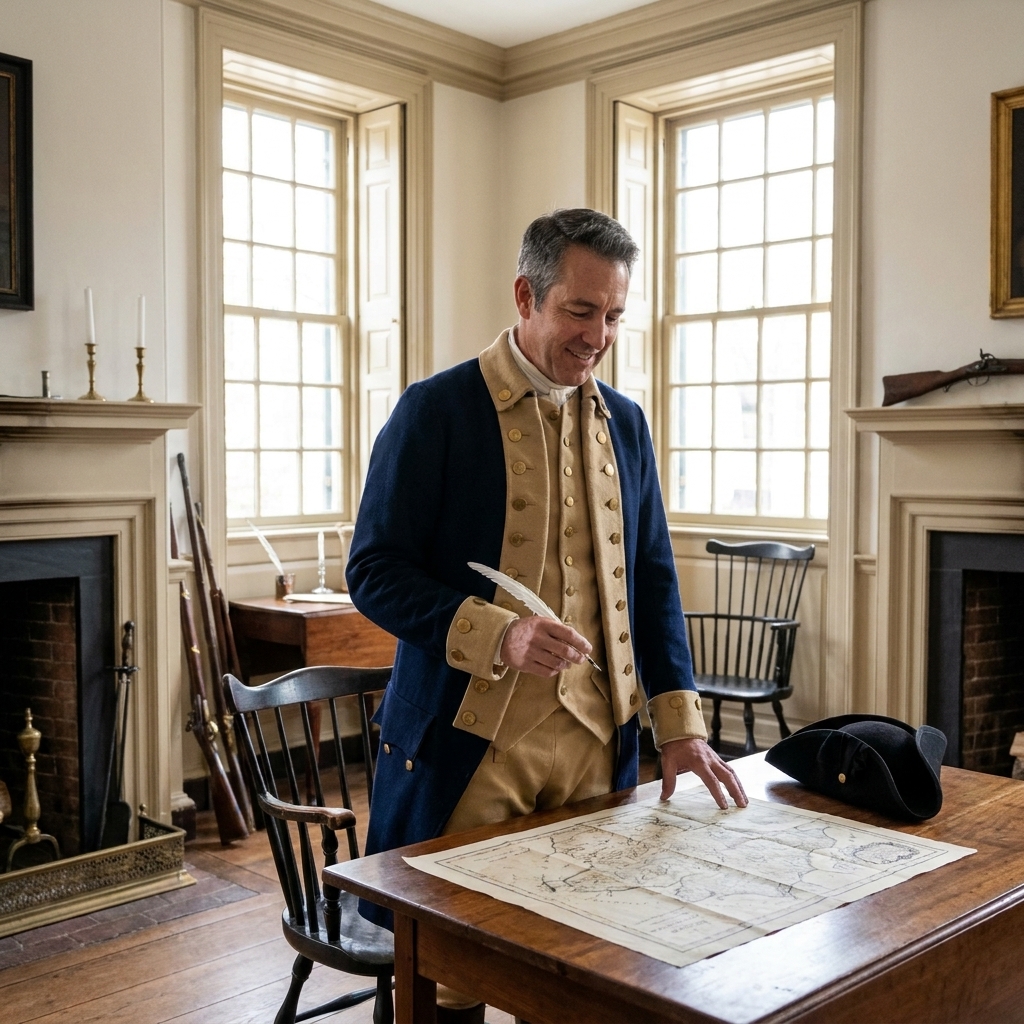
Before you judge any room as a “headquarters,” it helps to remember what that usually meant in the Revolutionary era. A headquarters was not a modern command center. It was a small network: the commander, a handful of aides and staff officers (think adjutants, engineers, quartermasters, and clerks), and a steady pulse of riders carrying orders, returns, and intelligence. Maps might be spread on a table, but just as often a campaign lived in notebooks, verbal briefings, and whatever the messenger could carry in a saddlebag.
That is why the physical setting matters. A headquarters could be a fine town house for weeks in an occupied city, or a farmhouse taken for a single night during a hard march. When you visit a surviving headquarters site, you are not just checking a box. You are looking for evidence of the commander’s habits. A few clues I always hunt for:
- Proximity to the front. Was the headquarters close enough to hear distant cannon, or safely tucked behind lines?
- Road access. Is it near major roads, ferries, or crossroads that would speed messenger traffic?
- Visibility. Do upper windows or nearby rises offer a view of approaches, rivers, or open fields?
- Space to operate. Is there a large room that could function as a map room, planning space, or dispatch hub?
- Security and comfort. Some leaders accepted discomfort for mobility. Others preferred stable quarters that supported staff work and logistics.
If you want a quick refresher on putting landscapes together on the fly, my on-site approach to maps is here: How to Read Revolutionary War Battlefield Maps on Site.
William Howe
Howe is an interesting commander to study in physical spaces because his greatest strengths and weaknesses both lean toward order. He was brave in combat and capable of large, complex operations. He also carried a habit that is easy to see in the way he campaigned: a preference for taking ground, consolidating, and waiting for the next clear opportunity.
That mindset made perfect sense for a professional European army that assumed time and resources were on Britain’s side. In America, that assumption was dangerous.
What to look for
When you tour sites tied to the New York and Philadelphia campaigns, think about what a stable headquarters offers a commander like Howe:
- Room for staff work. Dispatches, intelligence summaries, engineering reports, and supply coordination require order and quiet.
- Predictable control. Howe often sought situations where the British could maneuver into strong positions, then fight on terms they chose.
- Risk management. A secure headquarters matches a commander who does not want to gamble the army on uncertain pursuit.
Examples that fit
You can see Howe’s logic in the 1776 New York campaign. After the big win on Long Island, the British had a chance to press hard. Howe instead leaned toward method and consolidation, continuing the campaign with careful moves that kept his army in control of key terrain and waterways. Later, around White Plains, you again get that sense of a commander who prefers shaping the field, not sprinting into the unknown just because the enemy is running.
In 1777, taking Philadelphia was a real prize, and it came with an occupation problem: holding a major city, feeding an army, and managing a hostile countryside. That is headquarters thinking. It favors predictable routines, secure lodging, and the kind of street access that keeps messengers and staff flowing.
New York on foot
Howe’s 1776 campaign around New York is a great way to understand him because the landscape offered exactly what he liked: waterways for movement, strong defensive positions, and room to maneuver without being forced into a single do-or-die moment.
If you are tracing the campaign in a modern city, start here: Tracking the Battle of Brooklyn in Modern New York. As you walk, ask yourself a Howe-style question: if you can take the city and the river crossings, do you feel pressure to chase a beaten enemy into the countryside, or do you consolidate the prize?
Inside the room
In rooms associated with British command in occupied cities, look for the little things that suggest a preference for centralized control. Wide tables. Formal parlors that could become meeting spaces. Easy access to the street for messengers. Even the feel of the place matters. Is it designed for long workdays and steady planning, not quick jumps from crisis to crisis?
And because many specific headquarters buildings did not survive, I think in categories when I travel: occupied-city command houses, long-term billets near major roads and ferries, and places where staff work could happen without constant disruption. Those types of sites tend to match Howe’s rhythm.
Charles Cornwallis
Cornwallis reads very differently on the ground. Where Howe tends to feel like a commander who wants the campaign to behave, Cornwallis feels like a commander trying to make the enemy react. He pushed hard in the South, pursued hard, and accepted risk. Sometimes it worked brilliantly. Sometimes it pulled him farther from support than was wise.
What to look for
Cornwallis’s decision making makes the most sense when you picture a headquarters that is more like a moving command post than a long-term office.
- Short stays. A house used for a night or two, not weeks, fits a commander who is always trying to keep pressure on.
- Road and river logic. Cornwallis needed routes that fed men and supplies forward and allowed fast pursuit.
- Strain on logistics. The farther he pushed, the more he depended on fragile lines of communication and local foraging.
Examples that fit
In the southern war, Cornwallis’s marches and countermarches feel like a man trying to win by tempo. He could move fast, hit hard, and keep pressure on a rebel force that preferred not to be pinned. If you have ever visited a site tied to a marching campaign, you know the sensation: you stop thinking about grand plans and start thinking about tomorrow morning, the next ford, the next crossroads, and whether the wagons can keep up.
Yorktown
If you want one place where “headquarters decisions” feel painfully real, it is the Yorktown campaign. Cornwallis’s choice to establish a fixed position on the York River only looks straightforward until you remember two things at once: he was operating in a higher-command framework that emphasized a naval-supported base in Virginia, and he could not personally guarantee that the sea would stay friendly.
In other words, the headquarters problem becomes a geography problem. A room can be comfortable. A town can look defensible. But if you cannot guarantee the water, the map is lying to you.
If Yorktown is on your radar as a first or early big trip, I compared it with another famous turning point here: Saratoga vs. Yorktown: Which Turning Point Battlefield Should You Visit First?
What this says about British strategy
It is tempting to turn “Howe vs. Cornwallis” into a personality debate. I think the buildings and landscapes tell a broader story: Britain often fought the war as a sequence of operational problems, while the rebels treated it as a political war where survival was victory.
Howe’s headquarters world is the world of occupation, formal lines, and consolidating captured ground. Cornwallis’s headquarters world is the world of chasing an enemy who can melt away, of trying to end the war by breaking resistance in the countryside.
Both approaches had logic. Both ran into the same American truth: the war rarely gave the British the clean, decisive moment they wanted.
Quick comparison
| What you are looking at | Howe tendency | Cornwallis tendency |
|---|---|---|
| Choice of base | Secure, central, staff-friendly | Forward, temporary, tied to movement corridors |
| Operational rhythm | Capture, consolidate, pause | Pursue, pressure, pivot |
| Risk appetite | Lower, prefers control | Higher, accepts uncertainty |
| What can go wrong | Missed chances, enemy escapes | Overextension, isolation, supply strain |
Build a weekend trip
If you want to compare these leadership styles without turning your trip into a graduate seminar, I like a simple structure: one urban campaign landscape (Howe) and one endgame landscape (Cornwallis), with a smaller stop in between that explains how the war shifted from tidy lines to hard marching.
Stop 1: New York area
- Why it fits: Waterways, fortifications, and big operational decisions.
- What to do on foot: Walk the modern street grid and keep picturing 1776 roads, marshes, and heights.
- Use this guide: Tracking the Battle of Brooklyn in Modern New York
Stop 2: Turning points
Even if you do not make it to Saratoga right away, it is worth understanding how British strategic assumptions got tested. I laid out a practical visit-first comparison here: Saratoga vs. Yorktown.
Stop 3: Yorktown area
- Why it fits: A headquarters anchored to a port becomes vulnerable when the sea turns hostile.
- What to notice: River access, open approaches, and how quickly “defensible” becomes “boxed in.”
For the nuts and bolts of building an itinerary around sites like these, my planning page is here: Plan a Revolutionary War Site Visit.
Questions to ask on site
I keep a short list of questions that work in almost any preserved headquarters or campaign landscape. They are simple, but they force you to think like each man.
- If I were Howe, would this location help me control a city and an army at the same time?
- If I were Cornwallis, would this location help me move tomorrow morning?
- How many routes lead out? A headquarters with only one obvious exit is fine until the enemy controls it.
- Where do messages come from? Imagine riders arriving at all hours. Does the site feel plugged into a network, or isolated?
- What does this place assume about time? Comfort assumes time. A temporary base assumes urgency.
Why it matters
Standing where decisions were made does not magically solve the war, but it does something more useful. It reminds you that leadership is not just “strategy.” It is temperament, habits, and what a person values when the information is incomplete.
Howe valued control and consolidation. Cornwallis valued pressure and pursuit. Put those instincts inside real rooms and real landscapes, and the Revolution starts to feel less like a set of outcomes and more like a series of choices made under strain.
If you want to explore more commanders and the people around them, I keep my People guides collected here: Guide to Revolutionary War People.